Sunday, December 11, 2005

IGCC vs Cogen


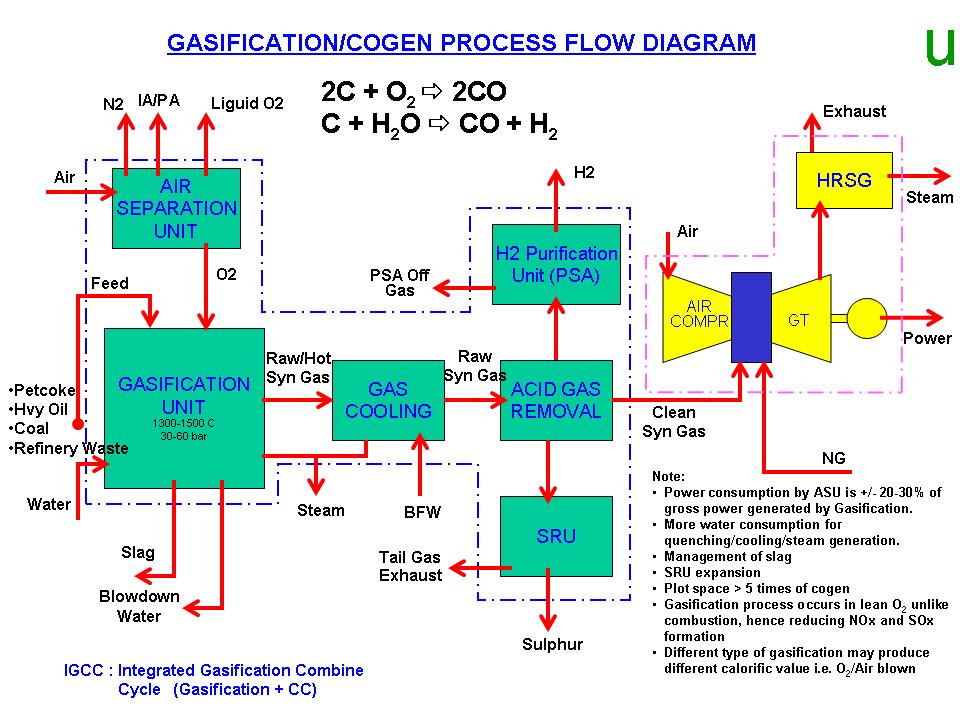
The viability of IGCC primarily depends on the difference of cost between IGCC Feed Fuel (in our case, Petcoke) and the Natural Gas. As can be seen, the cogeneration (GTG + HRSG) can be part of the overall IGCC scheme.
If the different of cost between IGCC Feed Fule and NG is not attractive and the capex of IGCC is very high, one could proceed with cogen first. This could be considered as 1st phase of the project. However, the cogen viability will depend on the difference of cost between self generation of power/steam vs buying power/steam from utility company. A thorough techno-economic assessment needs to be done prior to deciding IGCC, Cogen or maintain status quo.

Thursday, December 08, 2005

GE/NP's Std Practice

Frame V Turbines - MARK VDec 3, 2005 7:26 pm, by Rahul P SharmaSubject : Applications from the Instrumentation & Control dept.

Hello, We have three set of Frame V turbines... Two are MARK II Speedtronic controls and the third one is MARK V control... We are planning to upgrade the MARK IIs to MARK V now... The question is that in older turbines we did not have any proximity vibration sensors.... Only Casing vibrations were measured and recorded, using velometers.... In the newer machine we do have Bently Nevada's Proximity sensors installed BUT without Key Phasor probe and required PC interface, thereby making the system of little use.... The local supplier says that GE doesnt recommend proximity sensors for Vibration Monitoring... Only casing vibration is used for tripping the Machine... Is it right...?? Secondly, given this status and lack of clarity, should we ask for a new Bently Nevada's complete vibration monitoring system installed with the upgrade that we are planning...?? If yes, then how will the modifications for the Proximity sensor installations take place...?? If I am right, to install proximity probes the bearings should be drilled so that the tip of the proximity probe can be as close to the rotor as possible...!!!! And two such mounting arrangement will have to be made 90 degrees apart... Thanks and regards Rahul

Re: Frame V Turbines - MARK VDec 4, 2005 3:36 pm, by markvguy
It's true--GE still relies on the "seismic" vibration transducers for protecting even new turbines, including Frame 7Fxs (which also use B-N vibration monitors, but not generally for protection/tripping). You are correct; modifications will most likely have to be made to the bearings/bearing shells for installation of the proximity probes. It's a trade-off--if you've had vibration problems in the past, or need the additional vibration monitoring ability (for balancing), then the cost and scope of the modifications must be taken into account. Newer Mk V turbine control panels have the ability to accomodate proximity probes and possibly even key phasor inputs and the operator interfaces can perform vibration analysis with the information.

Re: Frame V Turbines - MARK VDec 6, 2005 9:55 pm, by Rahul
Thanks for the info... But I have a question... Is there a document somewhere, published by GE, that could be relied upon to convince the authorities here that even if Proximity Probes are not used it will not be detrimental to the functioning of the Machine and that only Seismic transducers are all what's needed for ensuring the safety of the machine... Thanks again, au revoir Rahul

Re: Frame V Turbines - MARK VDec 7, 2005 11:51 pm, by Joe Clappis
By virtue of the fact that GE has relied for decades on seismic vibration probes for unit protection for new units under warranty--and continues to rely on seismic vibration probes for unit protection for new units under warranty--should speak volumes for the safety of their application and use. B-N proximity probes have been known to have their own "ghost" problems, falsely indicating high vibration because of problems with melted/damaged prox cables and interconnecting wiring (i.e., usually because improper shield grounding practices and signal isolation not strictly adhered to). The big advantage to B-N probes is the ability to analyze pinpoint the problem quickly and apply a balance shot when necessary.

Re: Frame V Turbines - MARK VDec 7, 2005 12:54 am, by Joe ClappisBy the way, are you still able to obtain Mk V controls from GE? If not, can you provide the information about where to obtain Mk V panels and engineering/commissioning support for retrofit applications?

Seismic Vibration - Velocity & Accelerometer

Absolute vibration monitoring is perhaps the primary
method of machine health monitoring on steam turbines.
The type of transducer used is seismic (ie vibration of
turbine relative to earth) and can either be a velocity
transducer
or an accelerometer.

The choice of transducer has been the subject of debate
for many years and often the final decision is purely
subjective. A number of factors however should be
taken into account.

The steam turbine is a fairly simple machine when
considering vibration signatures.The frequencies of
interest are normally from one-half to five times running
speed (broadly 25 to 300Hz). The unique high frequency
detection capability of the accelerometer is not often
used.


Vibration monitoring is nearly always in terms of velocity
or displacement and can therefore be obtained by an
accelerometer or a velocity transducer.
Particular care
needs to be taken when double integrating an
accelerometer signal to provide a displacement
measurement. Problems usually occur below 10Hz when
double integrating and 5Hz when single integrating. In
the frequency ranges normally monitored on steam
turbines this is not a problem. These measurement
issues can be reduced by integrating the signal at source
rather than after running the signal through long cables
(ie having picked up noise on route). Accelerometers
with built-in stages of integration are available to perform
this task as discussed in the previous section.

Pedestal vibration is normally measured in the two axes
perpendicular to the shaft direction where the bearing is
under load, providing complete measurement coverage.
In some instances the thrust direction is also monitored
depending on turbine configuration.

Gas turbines demand high temperature transducers for
absolute vibration monitoring (>400º typ). For this
reason, a separate charge amplifier is normally utilised,
located away from the high temperature environment.


Difficulties can be encountered when monitoring the HP
turbine pedestals using accelerometers. The high
frequencies generated by steam noise can saturate the
amplifier electronics. Filtering the signal prior to the
charge amplifier will eliminate the problem but this must
be incorporated into the amplifier circuit of an
accelerometer with built in electronics.

In summary, the velocity transducer is simple and easy to
fit to a turbine but has limited frequency and phase
response (not a problem in the range 10 to 1000Hz) and
requires periodic maintenance. The accelerometer on the
other hand requires more careful installation but can then
be left without maintenance.

The velocity transducer has the advantage over the
accelerometer of being self generating and not requiring
any power supply. On the other hand, the accelerometer
has no moving parts and should not require frequent
calibration.

Seismic vs Proximity Probe

norzul (Mechanical)
5 Dec 05 2:25
Hi,We just procured gas turbine. Wonder whether is there any particular standard on using seismic or proximity probe for the alarm/tripping and protection of the machine.Someone told me that using proximity probe is not that common for tripping the GT? Is it trueThanksnorzul
Inappropriate post?If so, Red Flag it!
Check out the FAQarea for this forum!
Find A Job or Post a Job Opening Click Here.
rob768 (Mechanical)
5 Dec 05 6:20
I assume you mean accelerometer? It gives an earlier warning (increase in vibration level) than a proximity probe. If you measure an incresae in deflection, it is usually late or too late.
Thank rob768for this valuable post!
Inappropriate post?If so, Red Flag it!
Check out the FAQarea for this forum!
norzul (Mechanical)
5 Dec 05 7:01
Yes, seismic probe is based on acceleration (even though the unit is normally converted to velocity i.e. mm/s) whereas proximity probe is based on displacement (micrometer) i.e. eddy current In our case, the vendor had proposed that the seismic probe will be located on the compressor side casing of the GTG. This is for tripping (safeguarding) purpose. And the proximity probe (X-Y) at each radial bearing for radial vibration monitoring and thrust bearing to monitor the axial displacement.Is this a common setup for the GTG?Our company technical stds require that shutdown protection shall also be provided as well for the bearing (radial & thrust). So, what the supplier intend to provide is a clear deviation to our company std...Just checking whether the deviation is genuinely technical or due to some commercial reasons...
Inappropriate post?If so, Red Flag it!
Check out the FAQarea for this forum!
byrdj (Mechanical)
5 Dec 05 9:48
I'm not aware of current CT recomendations. For ST, the prox probes are becoming very popular (and used for protection). You could review the make and model of the prox probe equipment and see if relay contacts are provided that can be used.I would think the desired display from prox probes would be in V since the desired D for tripping would be a function of speed.Another item to know would be if the prox probes are absolute or relative. since relative measures gap between journal and bearing, it is possible for some bearing designs to vibrate in phase with journal and relative reading be very low for a severe condition. (a function of bearing support stiffness) Absolute usally have an acceleramoter included.I would also expect the thrust prox probes are for actual position (not axial vibration) monitoring to see a thrust bearing failure (wear) has occurred.
Thank byrdjfor this valuable post!
Inappropriate post?If so, Red Flag it!
Check out the FAQarea for this forum!
JJPellin (Mechanical)
5 Dec 05 11:45
We don't currently have any gas turbines in our plant. But I believe the protection requirements would be the same as a large steam turbine. The machine uses journal bearings which will tend to dampen out much of the shaft vibration. Case probes (seismic) could miss a potentially disastrous failure until extensive secondary damage had occurred. Typically, two radial probes on each bearing should be set up to trip the machine in a dual voting (2 out of 2) configuration. If both probes agree that the shaft displacement is above the danger level the machine should trip. The monitor will need to be set up so a failed probe or proximeter will not be counted as a vote to trip. Dual thrust probes should be set up the same way. The case probes are nice to have since the prox probes really are a relative measure (shaft versus housing). With a case probe, it is possible to subtract out the case movement and get absolute shaft movement. Also, prox probes have a high frequency limit and are not very good at detecting extremely high frequency events that might occur at blade pass or gear mesh frequencies. We would not normally set up the case probes to trip since they could be bumped in the field. On some machines, we also set the prox probes up to trip on gap in case the shaft centerline drops without substantial increase in overall radial vibration. We set up alarms for acceptance region that will alert us if the vibration levels drop or if the phase angle changes greatly.
Thank JJPellinfor this valuable post!
Inappropriate post?If so, Red Flag it!
Check out the FAQarea for this forum!
turboco1 (Mechanical)
5 Dec 05 18:48
Displacement probes for shaft movement in the vicinity of the probe. They cannot measure shaft bending away from the probe. Used to indicate problems of unbalance, oil whirl, misalignment.Velocity pickup detectors have flat response of amplitude as a function of frequency. Alarm setting is unchanged regardless of speed. Diagnostics is limited due to being very directional. If you change its direction of pickup the value of the same force will change.Acceleromters mounted on the casing pick up the spectrum of problems transmitted from the shaft to the casing and offer velocity regardless of frequency. Used to id hi-freq problems ie blade flutter, surge, etc..
Thank turboco1for this valuable post!
Inappropriate post?If so, Red Flag it!
Check out the FAQarea for this forum!
rob768 (Mechanical)
6 Dec 05 2:30
As far as I know there is a difference between a seismic probe and an accelerometer, allthough both use the same principle of measmurement. Seismic probes are used in the low frequency range, and as such function as last alarm when an installation is really breaking down. Accelerometers can be used for trending and giving early warming of wear, increasing unbalance and such. Proximity probes can measure shaft displacements that may accompany such phemonema.I'd personally go for vibration monitoring through accellerometers
Thank rob768for this valuable post!
Inappropriate post?If so, Red Flag it!
Check out the FAQarea for this forum!
TPL (Mechanical)
6 Dec 05 18:03
The fundamental choice of transducer depends on the type of bearing fitted to the GT - for industrial gas turbines fitted with journal/sleeve/tilting pad bearings (where the shaft is supported by an oil film and is able to move relative to the bearing surfaces) the preferred choice would be proximity probes, but for aeroderivative GTs, generally fitted with rolling element bearings (no shaft movement relative to bearing and nearly all forces transmitted to casing) a seismic type transucer would be the first choice - for a variety of technical reasons, moving coil velocity transducers have generally lost ground to solid state acclerometers.If a gearbox is present and fitted with journal type bearings, then both accelerometers (to measure high freuqneices associated with gear mesh frequencies) and proximity probes might be fitted

Reliability vs Availability?

norzul (Mechanical)
6 Dec 05 16:29
How can I best describe the differences between these 2 items?
Inappropriate post?If so, Red Flag it!
Check out the FAQarea for this forum!
Eng-Tips Forums is Member Supported. Click Here to donate.
CESSNA1 (Mechanical)
6 Dec 05 17:19
NORZUL: Basically the difference is as follows: RELIABILITY - The probability that a device will perform as designed. For example if 90% of a certain radio last their design life of say 5 years. Then their reliabiltiy is 90% AVAILABILITY - The number of items that will function as designed for For example - Suppose you and nine of your neighbors start out for work on monday, but only 8 of you make it because of mechanical problems, accidents, speeding tickets/etc. Then the availability for work is 80%.Actually it is a little more complex than this and there are equatiosn to define each one, but these are the basic basics.RegardsDave
Thank CESSNA1for this valuable post!
Inappropriate post?If so, Red Flag it!
Check out the FAQarea for this forum!
norzul (Mechanical)
6 Dec 05 17:54
TQ Dave. Is there such relationship between reliability and availability? or is it totally 2 different subject?Which is more reliable? To have 2 X 100% pumps (1 running & 1 spare) or 3 X 50% pumps (2 running & 1 spare)? Is the question relevant?In terms of availability which one has higher availability i.e. 2 X 100% pumps or 3 X 50% pumps? I used to hear that, in order to increase the reliability of a particular pump system we should diversify its source of power. For example having 2 motor-driven pumps + 1 steam turbine driven pump is more reliable compared to having 3 motor-driven pumps...? Is my logic right?Below is the definition that I've extracted from our company's technical standards:The reliability of a gas turbine is defined as the sum of the service hours (i.e. the period in which the unit is producing useful energy)divided by the sum of service hours plus forced outage hours, and is expressed as a percentage.Service Hours : SH; Plan Outage Hours : POH; Forced Outage Hours : FOHTotal Hours per year = SH + POH + FOH = 8760 hrsReliability = SH / (SH+FOH)The availability of a gas turbine is defined as the sum of the service hours (i.e. the period in which the unit is producing useful energy)divided by the sum of service hours plus total outage hours, and is expressed as a percentage.Availability = SH / (SH+FOH+POH)Based on the above definition, Availability will always be lower than Reliability...confused???
Inappropriate post?If so, Red Flag it!
Check out the FAQarea for this forum!
CESSNA1 (Mechanical)
6 Dec 05 19:00
NORZUL: Reliability and availability are two different animals, evin if they use some of the same information.Your pump question is frequently posed. Let me pose it in a different form as in the case of a twin light engine airplane. Many people say a twin is more reliable than a single engine because there are two engines. In fact the additional engine decreases reliability because it adds more parts and two the twin engine airplane is supposed to fly on two engines. No pilot in his right mind would try to fly a twin on one engine to save fuel or other inane reason. There are times that twins have an engine failure and the pilot has to fly on one engine, but it takes skill and some practice.The NUMBERS of availability are lower than reliability in your case, but Reliability and Availability are two different concepts. Your availability definition is a little restricted comapred to what we use. Our equation is: Sum of operating and standby hours divided by the sum of operating and standby hours plus sccheduled and unscheduled maintenance hours plus administrative and logistics delay hours.or: (operating + standby hours)/(operating + standy + maintenance + admin hours)To continue your pump question, you have to look at the system and the reliability and what failure means to you. Let us say that each pump has a reliability of 90%. If one pump is needed and there is a spare then you have 100% redundency, but 90% reliability, since only one is needed. Assuming the second pump comes on when needed.For the three pumps the reliability of the system is 90% times 90% or 81% since both pumps are required. reliable. The third pump increases the reliability from 81% to 90%, but it really gets tricky because if you have a pump failure and the standby pump comes online then you should immediately replace the broken pump to retore the system relaibilty. If both pumps fail togethethe standby pump cannot supply the needed flow.RegardsDavehalldp@efv.usmc.milIf you do not mind send me your phone number and we can talk.
Thank CESSNA1for this valuable post!
Inappropriate post?If so, Red Flag it!
Check out the FAQarea for this forum!
IRstuff (Aerospace)
6 Dec 05 22:27
If you are talking military, then:Availability = MTBF/(MTBF+MTTR+MLDT)where:MTBF = mean time between failuresMTTR = mean time to repairMLDT = mean logistical delay
TTFN
Thank IRstufffor this valuable post!
Inappropriate post?If so, Red Flag it!
Check out the FAQarea for this forum!
CESSNA1 (Mechanical)
7 Dec 05 10:54
IRSTUFF: Our equations are similar, and certainly different organizatins use different methodologies. It is the rational and the limitations that must be understood by all concerned. We crank in ADMIN dleay time which is usually small compared to other times.Even time is an issue: Is it clock time, or tachometer time, or engine run time, or master switch time, or time based on 12 hour days or what. Different organizations have different basis that must be understood.RegardsDave
Thank CESSNA1for this valuable post!
Inappropriate post?If so, Red Flag it!
Check out the FAQarea for this forum!
IRstuff (Aerospace)
7 Dec 05 12:52
MTBF time, at least for military systems, is usually power-on time. A typical system might have 1000 hr MTBF, which is about 1.4 months, so if it's on 24/7, be prepared to make lots of repairs.MTTR usually includes BIT and initialization time to verify failure and the successful repair, as well as any other associated troubleshooting time.MLDT would be measured from the time you figure what part is needed to when you get a new one, ready to install.
TTFN

norzul (Mechanical)
10 Dec 05 20:29
Is this definition right to differentiate reliability and availability?1) RELIABILITY describes an equipment or service’s level of failure. 2) AVAILABILITY describe an equipment or service’s readiness to perform its function on demand.
Inappropriate post?If so, Red Flag it!
Check out the FAQarea for this forum!

IRstuff (Aerospace)
10 Dec 05 23:01
From the equations, availability is derived from the reliability, but includes non-equipment factors, while the reliability is strictly a function of the equipment failure rate.
TTFN

norzul (Mechanical)
11 Dec 05 8:22
TQ IRstuff...but can yu elaborate further what do yu mean by "availability is derived from the reliability, but includes non-quipment factors".

Construction of Transformer

norzul (Mechanical)
1 Dec 05 13:41
Hi,I'm curently involved in a cogeneration plant project. We have procured few auxiliary transformer. Our technical standards specify the followings:"Oil-immersed transformers rated 1600 kVA and below shall be hermetically sealed. Transformers rated above 1600 kVA and up to 3150 kVA, may be either hermetically sealed or of the conservator type. However, hermetically sealed transformers above 3150 kVA shall be subject to Principal approval."However, the supplier requested for deviation and propose to supply the non-hermetically sealed type transformer for 250 kVA. Is this common in industry?Thanksnorzul
Inappropriate post?If so, Red Flag it!
Check out the FAQarea for this forum!
Find A Job or Post a Job Opening Click Here.
ScottyUK (Electrical)
1 Dec 05 14:23
Very small conservator types are not especially common in the UK. Hermetic transformers arguably require a little less maintenance, and this is the reason why they are more popular with the distribution companies. Conservator-type transformers usually have more complex instrumentation requirements than hermetics, but that is largely a factor of size and value; on such a small transformer it may not be considered economical to fit more than the basics.
---------------------------------- Start each day with a smile. Get it over with.
Thank ScottyUKfor this valuable post!
Inappropriate post?If so, Red Flag it!
Check out the FAQarea for this forum!
norzul (Mechanical)
1 Dec 05 14:37
TQ ScottyUK....appreciate if you can further qualify what do yu mean by "factor of size and value". Just wonder...for this small transformer why the supplier insist to supply the conservator type. From cost point of view I think it is more expansive. From maintenance point of view, looks like we may require more maintenance. It's like loose-loose situation not win-win...?? Fyi..the contract that we have is lump sum type i.e. we are not going to pay for the additional cost incurred by the supplier.
Inappropriate post?If so, Red Flag it!
Check out the FAQarea for this forum!
ScottyUK (Electrical)
2 Dec 05 2:45
The comment regarding "...size and value..." was really to suggest that although most conservator-type transformers have more instruments and protection functions, this isn't solely because they are of that design. Larger transformers tend to supply larger loads, or multiple small loads, and loss of such a transformer typically causes greater disruption than loss of a small type. They are also major capital assets, and the cost of better protection is a diminishing percentage of total cost as the transformer size increases, so it becomes economical to find sophisticated protection to, say, a GSU transformer whereas that protection might cost more than the total value of a small distribution transformer.That logic doesn't entirely apply to your excitation transformer because loss of that one small transformer will shut down the generator just as effectively as loss of the GSU transformer, unless you are very lucky and have redundant excitation transformers. It would however be a relatively small task to remove and replace the excitation transformer if it failed, and relatively inexpensive to hold one as a spare for that eventuality.So far as why so supplier wants to supply a conservator type, I can only guess that they have no experience of hermetic types, or are using a stock design rather than devloping a new one, or they have some stock of the conservator type already available.
---------------------------------- Start each day with a smile. Get it over with.
Thank ScottyUKfor this valuable post!
Inappropriate post?If so, Red Flag it!
Check out the FAQarea for this forum!
ScottyUK (Electrical)
2 Dec 05 2:47
Oops - I said 'excitation transformer' when should have said 'auxiliary transformer'. Thoughts from my real job spilling through into my online one!
---------------------------------- Start each day with a smile. Get it over with.
Thank ScottyUKfor this valuable post!
Inappropriate post?If so, Red Flag it!
Check out the FAQarea for this forum!
norzul (Mechanical)
2 Dec 05 17:09
What are the disadvantages of hermetically sealed transformer as compared to that of conservator type?
Inappropriate post?If so, Red Flag it!
Check out the FAQarea for this forum!
Electic (Electrical)
2 Dec 05 17:23
Norzul,I am not sure where you are located but in the USA I have not heard of 'hermetically sealed' transformers for normal distribution duty in the size you are specifying.I would expect either a welded tank or gasketed bolted tank with a pressure relief valve, fill and drain valves, bolt on bushings, bayonet fuse etc; most of which would preclude 'hermetically sealed'.I suggest you find a brand name you trust and go to their website or catalog and seek how their transformers are constructed, maybe check a couple of them out and write a spec about what you really need after seeing this.
Thank Electicfor this valuable post!
Inappropriate post?If so, Red Flag it!
Check out the FAQarea for this forum!
norzul (Mechanical)
2 Dec 05 17:44
Dear Electic/Guys,Fyi, I'm currently involved in a cogeneration project, 120 MW (4 Gas Turbines + 4 Heat Recovery Steam Generators + 1 Steam Turbine). It is a lump sum turnkey kind of project. Now, the status is towards the end of detailed design/procurement phase. We'd issued POs for the GTs and ST. Our company's technical standards require hermetically sealed transformer for 1600 kVA and below.The GT supplier complies with our stds. Unfortunately the ST supplier doesn't comply. The problem is, we just realized about this. Contractually we could still force them to comply....but...the schedule most likely will be affected & cause project delay...1st I try to convince myself that the conservator type is perfectly OK and perhaps more technically superior as compared to that of hermetically seal...before I go to my management for explanation...Thanksnorzul
Inappropriate post?If so, Red Flag it!
Check out the FAQarea for this forum!
norzul (Mechanical)
2 Dec 05 17:50
Actually I'm looking for technical justifications to have conservator type transformer...perhaps yu guys can help me...since I'm not an electrical engr by dicipline.
Inappropriate post?If so, Red Flag it!
Check out the FAQarea for this forum!
Electic (Electrical)
2 Dec 05 21:05
If I understand correctly the conservator type transformer is more appropriate for larger transformers over 10MVA. Even then it is a rarity these days with most manufacturers offering a nitrogen blanket system instead.Read my previous post about standard specs for the size of transformer you anticipate. Hermetically sealled and Conservator both sound like oddballs for 1.6MVA.
Thank Electicfor this valuable post!
Inappropriate post?If so, Red Flag it!
Check out the FAQarea for this forum!
norzul (Mechanical)
3 Dec 05 4:25
TQ Electic....I do agree with yu, however what I don't understand is why conservator type is appropriate for larger transformer over 10MVA i.e. needs for technical explanation
Inappropriate post?If so, Red Flag it!
Check out the FAQarea for this forum!
matwong (Electrical)
4 Dec 05 23:45
In our case, we accept both type of trxs for our distribution network and there is no preference to any one of them. Personally, I will think this is the design concept adopted by different manufacturers where they will normally stick to the type that they have sent for type-test(for that particular ranges of trxs).The hermetically sealed type as mentioned earlier by ScottyUK claims to be "less maintenance" than conservator type. For the latter, one needs to replace the silica gel for the breather more often.Electric, Just wonder what is the normal distribution size of transformer used in USA if not as mentioned by norzul (1600kVA and below) ? FYI, hermetically sealed trx can be either adopted gas cushion (I presume same as nitrogen blanket) or thinner cooling fin system for 'breathing' purposes which are both acceptable in our MV distribution system.